- info@digitalworld.co.ke
- Nairobi, Kenya

How to Build a Business Website in Kenya in 2024 (Complete Guide)

27
Oct
Why Your Kenyan Business Needs a Website in 2024
With over 22 million internet users in Kenya and mobile internet penetration growing at double digits every year, a professional website is no longer optional for Kenyan businesses — it is essential. Whether you run an SME in Nairobi, a retail shop in Mombasa, or a consultancy in Kisumu, your customers are searching for you online right now.
In this guide, Digital World Kenya — a leading web development company in Nairobi — walks you through everything you need to know to get your business online in 2024.
Step 1: Define Your Goals Before You Build
Before touching a single line of code or choosing a platform, you need to answer one question: what should your website do for your business?
- Generate leads and enquiries?
- Sell products online with MPesa payment?
- Provide information about your services?
- Build brand credibility and trust?
Your goals determine everything — the design, the features, the platform, and the budget.
Step 2: Choose the Right Platform
Kenyan businesses typically choose between three main options:
- WordPress — best for content-heavy sites, blogs, and businesses that want to manage their own content easily. Highly extensible with plugins.
- Custom Laravel/PHP — ideal for businesses that need custom workflows, MPesa integration, or complex databases. This is what Digital World Kenya builds for mid-to-large clients.
- Shopify / WooCommerce — suitable for e-commerce businesses, though MPesa integration requires careful setup for Kenyan payments.
For most Kenyan SMEs, a custom-built Laravel website with a CMS gives the best long-term value.
Step 3: Get a .co.ke Domain and Kenyan Hosting
A .co.ke domain (available from KENIC registrars) builds local trust and helps your site rank on Google Kenya. Pair it with a reliable Kenyan hosting provider or a global cloud host with a CDN presence in Africa for fast load times.
Tip: Site speed is a ranking factor for Google Kenya. Slow websites lose both visitors and search rankings.
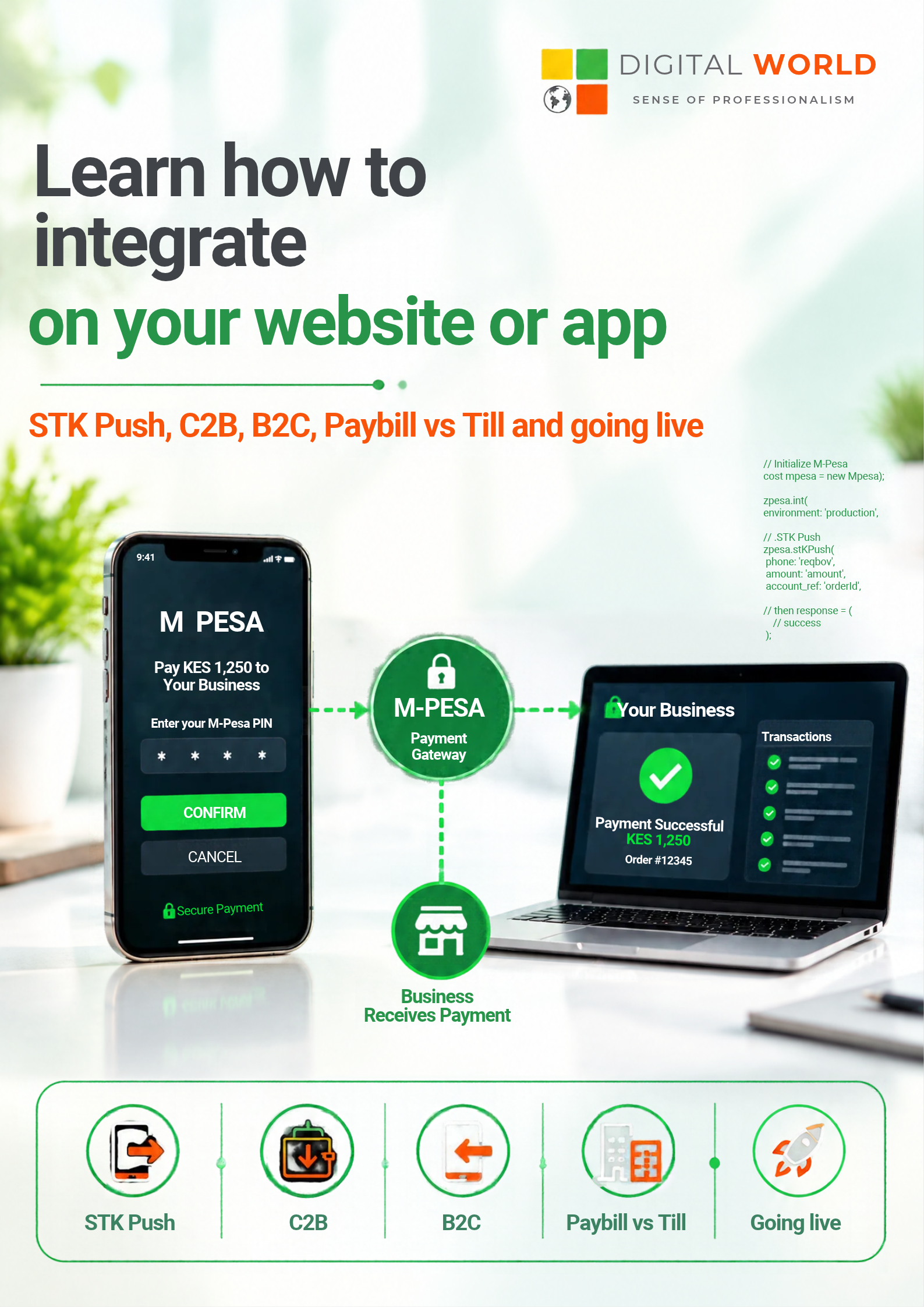
Step 4: Integrate MPesa Payments
If your website will accept payments, MPesa integration is non-negotiable in Kenya. Safaricom's Daraja API supports:
- STK Push — prompts a payment request directly on the customer's phone
- C2B — customer sends money to your Paybill or Till number
- B2C — business sends money to customers (for refunds, payouts, etc.)
Digital World Kenya integrates MPesa into every e-commerce and SaaS platform we build. Contact us for a free consultation.
Step 5: Optimise for Mobile Users
Over 80% of Kenyan internet users browse on smartphones. If your website is not mobile-responsive, you are losing the majority of your potential customers immediately. Every website Digital World Kenya builds is mobile-first by design.
How Much Does a Business Website Cost in Kenya?
Website development costs in Kenya typically range:
- Basic 5-page website: KES 20,000 – 40,000
- Business website with CMS: KES 50,000 – 120,000
- E-commerce with MPesa: KES 80,000 – 200,000+
- Custom web application: KES 150,000+
At Digital World Kenya, we offer transparent pricing with no hidden costs. View our pricing plans or request a custom quote.
Conclusion
Building a business website in Kenya in 2024 requires clear goals, the right technology partner, and a focus on mobile users and local payment methods. Digital World Kenya has delivered over 200 websites and web applications to Kenyan businesses. We understand the local market, and we build solutions that work.
Ready to get started? Contact Digital World Kenya today for a free 30-minute consultation.